
My son wanted Iceland for his high school graduation trip. Not the beach. Not Disney. Iceland — volcanoes, waterfalls, arctic foxes, and terrain that has absolutely no business being on a mobility traveler’s itinerary.
We went anyway. August 2022.
That’s how every trip starts — not with a careful assessment of whether someone with CMT Type 1A has any business going somewhere, but with a want so loud it drowns out the logistics. A friend texts “want to go to Norway?” A photo stops the scroll. A kid picks a graduation destination that makes you quietly terrified and you say yes because what else are you going to say.
The fantasy always lands first.
Plan.
The first thing I type is always some version of “what is ___ known for?” or “history of ___?” — into Google, increasingly into Claude. Not because I don’t know anything about the place. Because I want to know what the place thinks it is before I decide what I think about it.
That query opens the door. Then I walk through it with Google Maps.
I zoom in and start asking “what is that?” like a toddler who just learned the question. I don’t stop until I have answers — or until I’ve screenshot enough mysteries to fill a second research session.
What I’m looking for at this stage has nothing to do with accessibility. Not yet. First I want to know what makes this place this place — the Catholic churches, the UNESCO sites, the local food and drink, the handmade crafts that take real digging to find because they’re not in the tourist shops and they’re definitely not made in China. Desire goes on the table before I start negotiating with my body about what’s possible.
The Louvre is not accessible. I went anyway. The Louvre is the Louvre.
Once I know what I want, the real research starts. I watch other people’s travel videos — not for the scenery but for the physical intelligence buried inside it. How long did it take them? Did they mention steps? Are they younger than me and visibly wrecked by the end? Nobody writes “charming historic district, seventeen steps with no rail, quarter mile of cobblestones that will destroy your knees.” They write “very walkable.” I have learned — at real cost — that “very walkable” is a lie told by people with functioning peripheral nerves.
So I read between those lines. I pause videos on curb cuts. I zoom in on terrain. I look for rails. I look at Viator for private drivers — because a private driver means I control the day. I can decide in the moment what works and what doesn’t, without explaining myself to a tour group or a guide with a flag on a stick.
What I’m building isn’t a schedule. It’s a menu. Ambitious version, moderate version, café-and-a-glass-of-something version. All of them planned. All of them valid. Because CMT is not consistent — some days my body cooperates completely, some days it’s fighting me before I leave the hotel room — and I cannot know on departure day which version of myself is going to show up.
So I plan for all of them.
Adapt.
Iceland. My son wanted to go into the volcano — a mile over rocky terrain, then a lift deep into the earth. I wanted to go. I knew I couldn’t. So I sent him and my husband with a camera and strict instructions to document everything. They came back with photos of an arctic fox and an excellent story. I heard every detail. I asked until they ran out of answers.
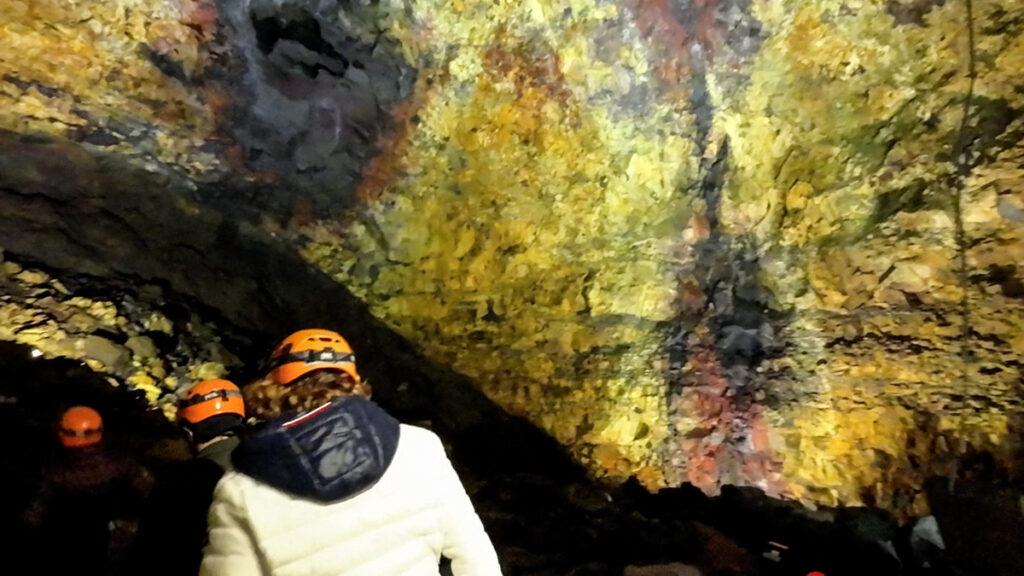
A mile of rocky terrain and a lift into the earth. My son went. I waited. He came back with this.
Some experiences you live through someone else’s camera. This one was worth it.
That’s not settling. That’s adaptation — which is different, and matters.
Adaptation happens in the planning phase too. Norway in October 2026 is coming, and my scooter will be completely useless on ice and snow. Ice means falling. Falling means I’ve already done it once this year and I have absolutely no interest in a repeat. So right now I’m watching YouTube videos of power wheelchairs on snow, researching ice cleats, looking at heated gloves, studying how people with serious mobility challenges navigate winter terrain in places that weren’t designed with any of us in mind.
I don’t have all the answers yet. I booked it anyway.
Adaptation also means reading the moment honestly. The Cathedral of Messina has one of the most spectacular animated clocks in the world — golden figures, lions, a rooster, the whole square stopping on the hour to watch. By that point in the trip I was done. Knees aching, feet unreliable, patience gone. I watched the clock from the square while my husband went inside.
That was enough. That was the right call.
The Pietà at Notre Dame — couldn’t make the stairs, no rail, not willing to use the wheelchair lift. So I zoomed in with my camera from below and looked at it that way. Was it perfect? No. Did I see it? Yes.
Adaptation is not failure.
Go.
We booked Norway anyway. Before I knew how to handle the ice, before I found the right equipment, before I had a single answer to the questions keeping me up at night. We booked it because that’s how this works — the commitment comes before the solution. You decide you’re going, then you figure out how.
Because here’s the thing: if I’d waited until I was certain Iceland was manageable, we’d have missed it. If I’d waited until I knew exactly how to handle Norway, I’d still be sitting in Austin missing it.
CMT will have opinions about every single trip I take.
I have learned not to ask for its input.
Plan. Adapt. Go!